Multi-Agent Systems
Coordination and collaboration among intelligent agents.
Agentic intelligence
Exploring intelligent agents that reason, learn, and collaborate.
Ph.D. Student in Computer Science
CUHK-Shenzhen
Advised by Prof. Zhongxiang Dai
About
I am a first-year Ph.D. student in Computer Science at The Chinese University of Hong Kong, Shenzhen (CUHK-Shenzhen), advised by Prof. Zhongxiang Dai. My research lies at the intersection of Large Language Models (LLMs) and Reinforcement Learning.
Prior to my doctoral studies, I was a Research Assistant in the same group. I earned my B.S. in Computer Science from Lanzhou University. I am always open to academic collaboration — feel free to reach out.
Coordination and collaboration among intelligent agents.
Language models that plan, act, and adapt.
Learning through interaction, with a focus on sample efficiency and generalization.
Agents that learn and improve continually for quantitative investing.
Agents, learning, and decision-making.
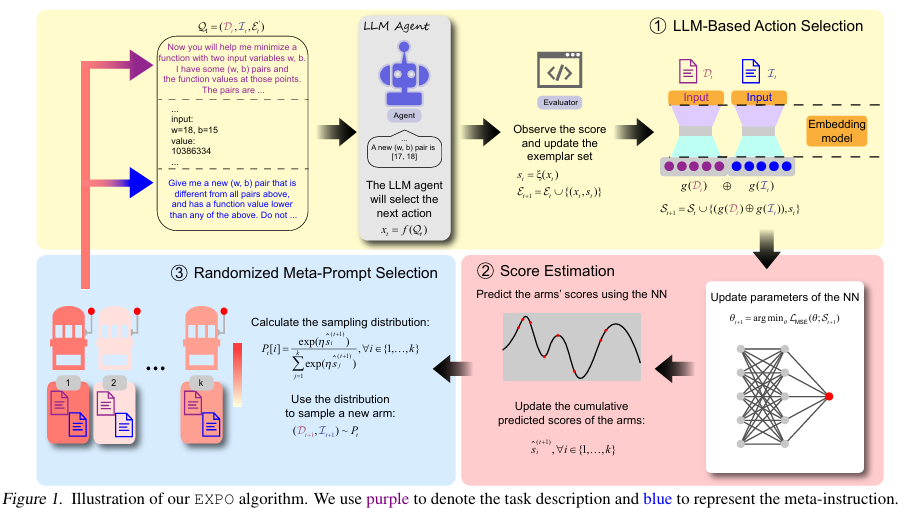
Optimizing LLM agent prompts online for sequential decision-making.
Large language models (LLMs) have recently been employed as agents to solve sequential decision-making tasks such as Bayesian optimization and multi-armed bandits (MAB). These works usually adopt an LLM for sequential action selection by providing it with a fixed, manually designed meta-prompt. However, numerous previous works have found that the prompt has a significant impact on the performance of the LLM, which calls for a method to automatically optimize the meta-prompt for LLM-based agents. Unfortunately, the non-stationarity in the reward observations during LLM-based sequential decision-making makes meta-prompt optimization highly challenging. To address this challenge, we draw inspirations from adversarial bandit algorithms, which are inherently capable of handling non-stationary reward observations. Building on this foundation, we propose our EXPonential-weight algorithm for prompt Optimization (EXPO) to automatically optimize the task description and meta-instruction in the meta-prompt for LLM-based agents. We also extend EXPO to additionally optimize the exemplars (i.e., history of interactions) in the meta-prompt to further enhance the performance, hence introducing our EXPO-ES algorithm. We use extensive experiments to show that our algorithms significantly improve the performance of LLM-based sequential decision-making.
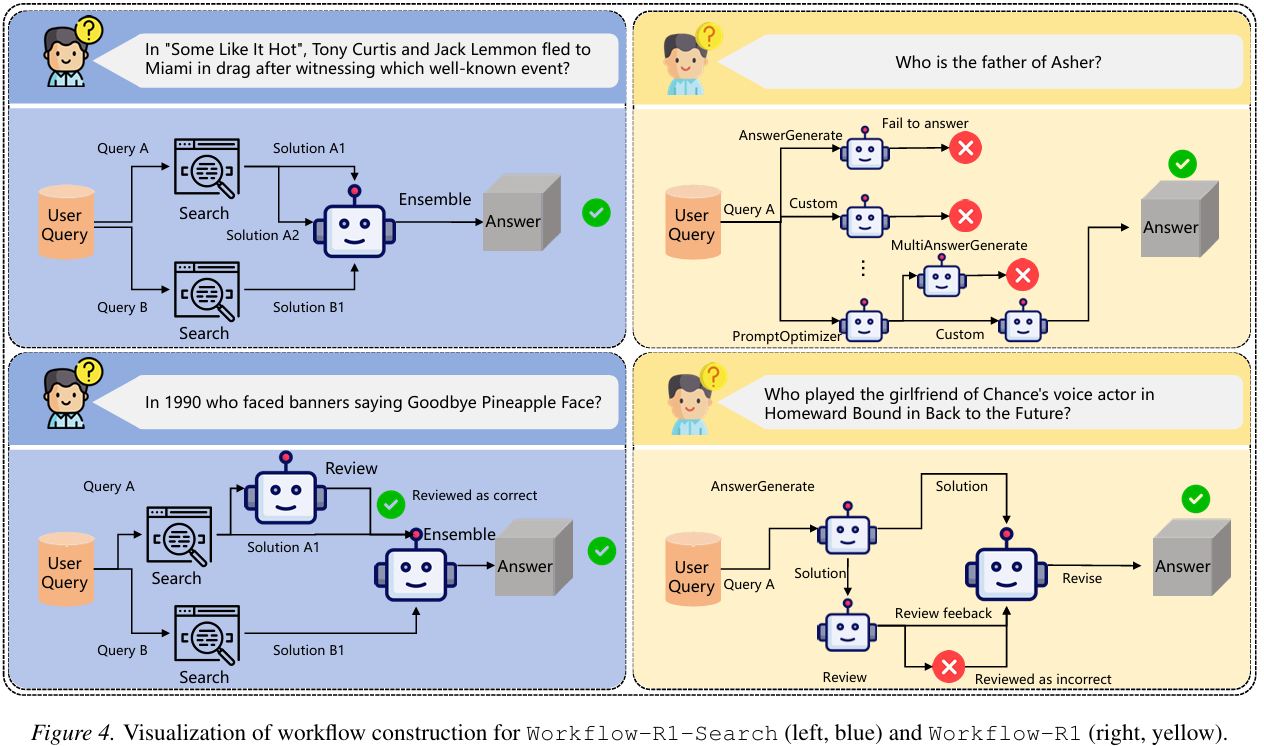
Learning to build multi-turn agent workflows through structure-aware reinforcement learning.
The rapid evolution of agentic workflows has demonstrated strong performance of LLM-based agents in addressing complex reasoning tasks. However, existing workflow optimization methods typically formulate workflow synthesis as a static, one-shot code-centric generation problem. This paradigm imposes excessive constraints on the model's coding capabilities and restricts the flexibility required for dynamic problem-solving. In this paper, we present Workflow-R1, a framework that reformulates workflow construction as a multi-turn, natural language-based sequential decision-making process. To resolve the optimization granularity mismatch inherent in such multi-turn interactions, we introduce Group Sub-sequence Policy Optimization (GSsPO). While explicitly tailored to align with the interleaved Think-Action dynamics of agentic reasoning, GSsPO fundamentally functions as a structure-aware RL algorithm generalizable to a broad class of multi-turn agentic sequential decision-making tasks. By recalibrating the optimization unit to the composite sub-sequence, specifically the atomic Think-Action cycle, it aligns gradient updates with the semantic boundaries of these interactions, ensuring robust learning in complex multi-turn reasoning tasks. Through extensive experiments on multiple QA benchmarks, Workflow-R1 outperforms competitive baselines, validating GSsPO as a generalized solution for sequential reasoning and establishing Workflow-R1 as a promising new paradigm for automated workflow optimization.
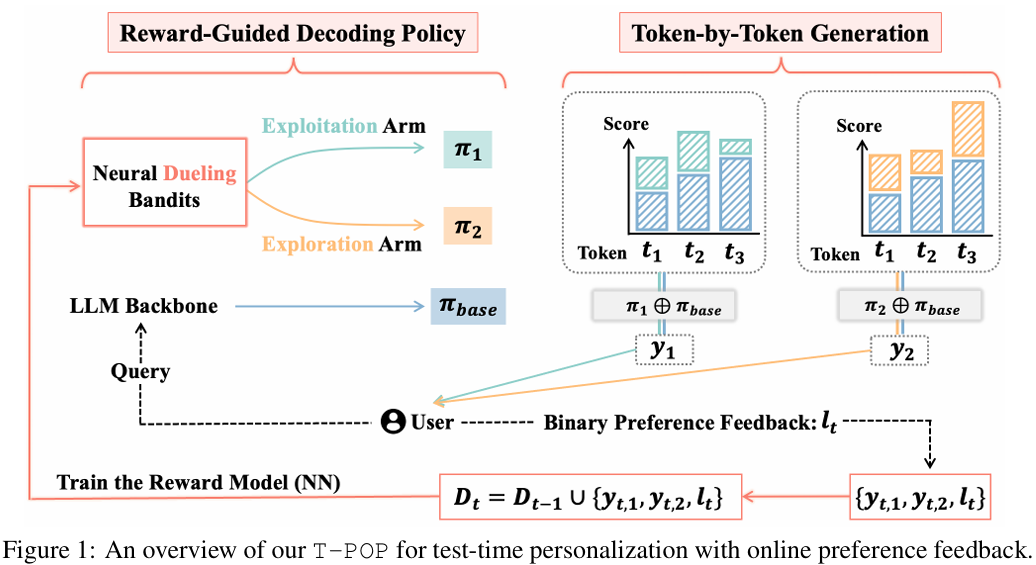
Personalizing a frozen LLM through online preference feedback.
Personalizing large language models (LLMs) to individual user preferences is a critical step beyond generating generically helpful responses. However, current personalization methods are ill-suited for new users, as they typically require either slow, resource-intensive fine-tuning or a substantial amount of pre-existing user data, creating a significant cold-start problem. To address this challenge, we introduce a new paradigm for real-time personalization by learning from online pairwise preference feedback collected during text generation. We propose T-POP (Test-Time Personalization with Online Preference Feedback), a novel algorithm that synergistically combines test-time alignment with dueling bandits. Without updating the LLM parameters, T-POP steers the decoding process of a frozen LLM by learning a reward function online that captures user preferences. By leveraging dueling bandits, T-POP intelligently queries the user to efficiently balance between exploring their preferences and exploiting the learned knowledge to generate personalized text. Extensive experiments demonstrate that T-POP achieves rapid and data-efficient personalization, significantly outperforming existing baselines and showing consistent improvement with more user interactions.
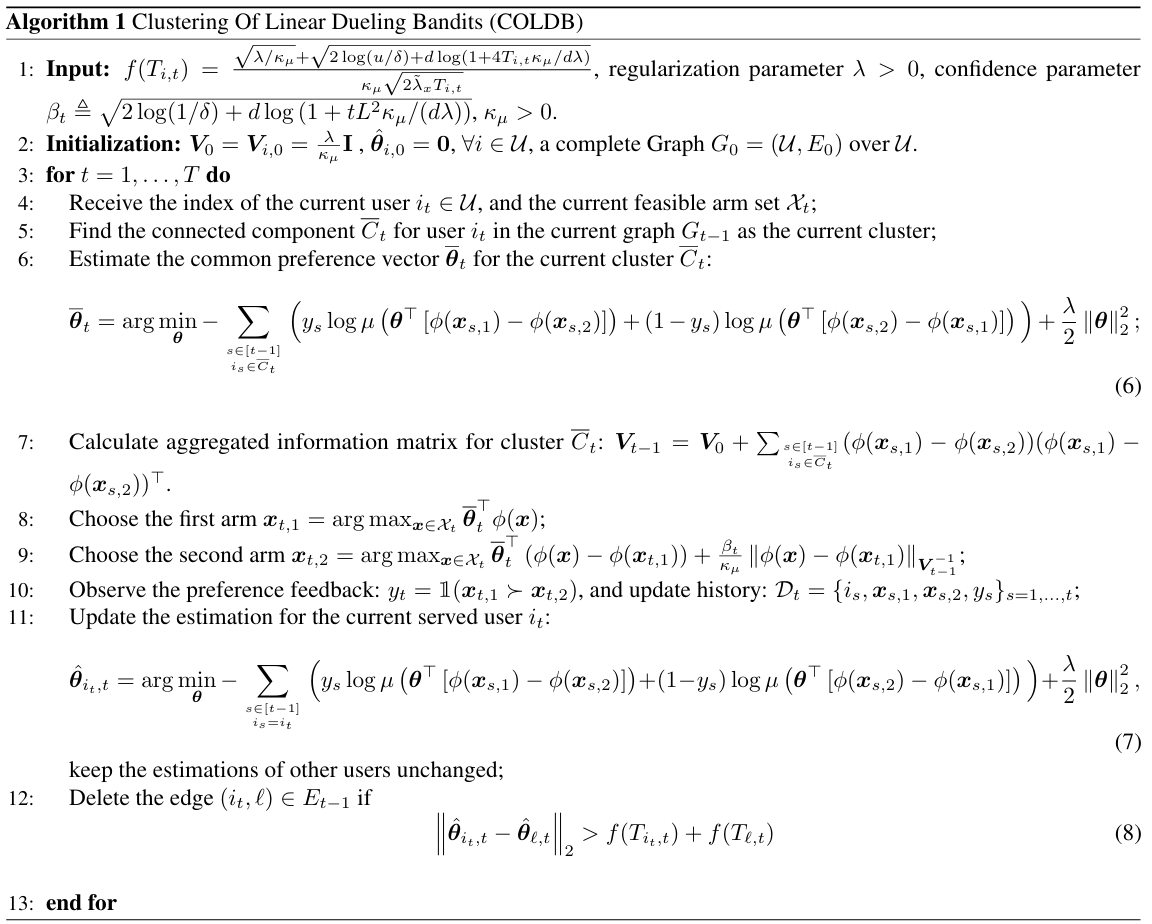
Collaborative decision-making through user clustering and pairwise preference feedback.
The contextual multi-armed bandit (MAB) is a widely used framework for problems requiring sequential decision-making under uncertainty, such as recommendation systems. In applications involving a large number of users, the performance of contextual MAB can be significantly improved by facilitating collaboration among multiple users. This has been achieved by the clustering of bandits (CB) methods, which adaptively group the users into different clusters and achieve collaboration by allowing the users in the same cluster to share data. However, classical CB algorithms typically rely on numerical reward feedback, which may not be practical in certain real-world applications. For instance, in recommendation systems, it is more realistic and reliable to solicit preference feedback between pairs of recommended items rather than absolute rewards. To address this limitation, we introduce the first "clustering of dueling bandit algorithms" to enable collaborative decision-making based on preference feedback. We propose two novel algorithms: (1) Clustering of Linear Dueling Bandits (COLDB) which models the user reward functions as linear functions of the context vectors, and (2) Clustering of Neural Dueling Bandits (CONDB) which uses a neural network to model complex, non-linear user reward functions. Both algorithms are supported by rigorous theoretical analyses, demonstrating that user collaboration leads to improved regret bounds. Extensive empirical evaluations on synthetic and real-world datasets further validate the effectiveness of our methods, establishing their potential in real-world applications involving multiple users with preference-based feedback.